Date Published 19 October 2026
Autumn has definitely arrived in Upton and Poole.
The windows are staying closed for longer, washing is being dried indoors and many of us are trying to decide whether it is cold enough to put the heating on—or whether another jumper will do for now.
Unfortunately, this is also the time of year when condensation, damp and mould problems begin to make themselves known.
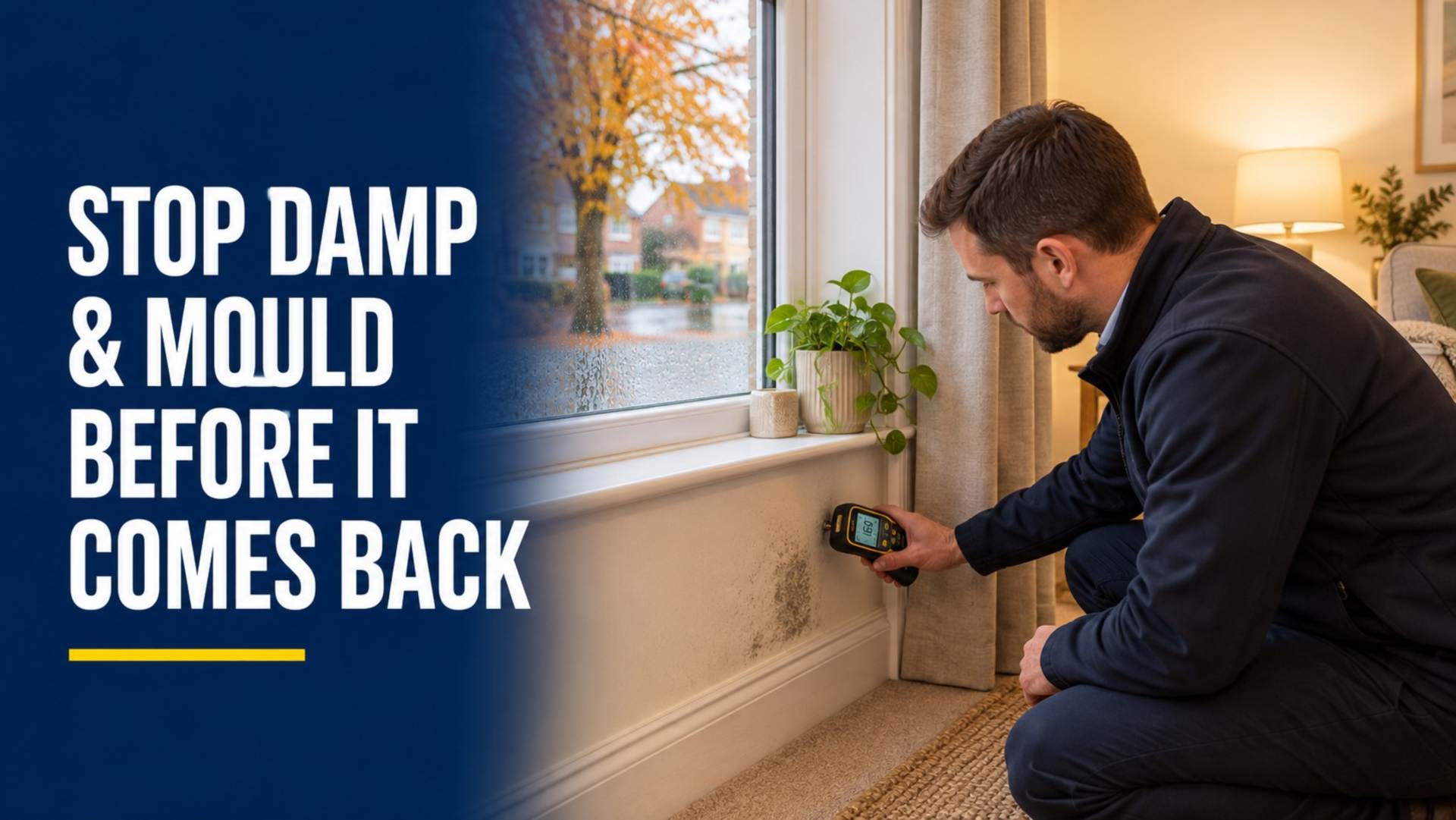
A tenant may report black marks around a window, mould behind a wardrobe or a damp smell in a bedroom. The natural reaction is often to arrange a mould wash, repaint the affected area and consider the problem dealt with.
Sometimes that works.
But if the mould returns a few months later, the landlord is back where they started—another inspection, another contractor, more decoration and an understandably frustrated tenant.
The most expensive mould treatment is often the one you have to pay for twice.
The rules became tougher in 2026
Since 22 June 2026, councils in England have been able to impose civil penalties of up to £7,000 in certain cases involving serious hazards in rented homes.
This can apply where a Category 1 hazard exists and the council believes it would have been reasonably practicable for the responsible person—usually the landlord—to remove the hazard, but they failed to do so.
Damp and mould is one of the 21 hazards assessed under the Housing Health and Safety Rating System. However, not every small patch of mould will automatically be classed as a Category 1 hazard. The seriousness depends on the condition of the property, the extent of the problem and the risk it creates for the people living there.
The important message for landlords is simple: damp and mould should be investigated properly rather than cleaned away and forgotten.
Start with investigation—not blame
Damp and mould can be a sensitive subject.
Landlords may feel the tenant is not ventilating the home properly. Tenants may believe the landlord has ignored a defect in the property.
Occasionally, everybody becomes so focused on proving who is responsible that nobody concentrates on solving the actual problem.
The sensible starting point is investigation.
Government guidance is clear that landlords should identify and deal with the underlying causes. Simply removing surface mould will not prevent it from returning if the moisture source remains.
That doesn't mean the way a property is occupied is irrelevant.
Cooking, showering, drying clothes and even breathing all add moisture to the air. How the heating and ventilation are used can make a considerable difference.
However, landlords should not automatically assume that a tenant's lifestyle is the sole cause.
The property itself may have:
A leaking roof or gutter.
Defective pointing or render.
A plumbing leak.
Failed window seals.
Blocked air bricks.
Missing or inadequate insulation.
A broken extractor fan.
Poorly positioned ventilation.
Cold external walls.
Furniture restricting airflow.
A heating system that is difficult or expensive to operate.
More than one of these problems at the same time.
The aim is not to find somebody to blame.
It is to find out where the moisture is coming from and what needs to change.
Why does mould often return?
Cleaning removes the visible growth, but it doesn't necessarily change the conditions that allowed it to develop.
If the wall remains cold, the leak continues or the ventilation is inadequate, moisture will keep collecting.
The wall may look lovely after being redecorated in September, only for the mould to reappear by Christmas.
That is frustrating for the tenant and expensive for the landlord.
Before redecorating, ask:
Has the moisture source been identified?
Has any leak been properly repaired?
Is the extractor fan working effectively?
Is there adequate background ventilation?
Is the affected surface still damp?
Does the wall need time to dry?
Is insulation missing or damaged?
Has the same problem happened before?
Is specialist advice required?
Anti-mould paint can form part of the solution, but it cannot repair a leaking gutter or stop condensation forming on an exceptionally cold surface.
Tip 1: Carry out an autumn property check
Landlords don't need to wait for a tenant to report mould before looking for warning signs.
Autumn is a good time to check:
Roof tiles.
Gutters and downpipes.
External walls and pointing.
Window seals.
Air bricks and vents.
Extractor fans.
Plumbing beneath sinks and baths.
Silicone seals around showers.
Loft insulation.
Signs of staining on ceilings or walls.
Condensation around windows.
Musty smells inside cupboards.
Mould behind large items of furniture.
Different properties have different weak points.
Upton and Poole have everything from older cottages and converted flats to bungalows, family houses and modern developments. A problem common in one property type may be completely different in another.
Knowing the individual property—and keeping a history of previous issues—can be extremely useful.
Tip 2: Make sure extractor fans actually work
It is easy to assume a fan is working because it makes a noise.
That doesn't necessarily mean it is extracting air effectively.
Fans can become clogged with dust, vent into the wrong space or simply be too weak for the room. Some have been switched off at an isolator because the tenant found the noise annoying. Others continue humming away while moving very little air.
Check that bathroom and kitchen fans:
Switch on correctly.
Run for an appropriate period.
Are clean.
Vent to the outside.
Have not been obstructed.
Are suitable for the room.
Are repaired promptly if they fail.
If a tenant reports persistent condensation despite using the fan, don't simply tell them to open a window. The ventilation itself may need to be assessed.
Tip 3: Check whether the home can be heated properly
Cold surfaces make condensation more likely.
A tenant may technically have a working heating system but still struggle to heat the property evenly.
There could be:
Faulty radiators.
An inefficient boiler.
Poor controls.
Draughts.
Missing insulation.
A particularly cold room.
A financial reason why the tenant is limiting their heating.
Landlords aren't responsible for paying a tenant's energy bills, but they should make sure the heating is safe, functional and reasonably capable of heating the home.
If one room is repeatedly affected, ask why that room is colder than the rest.
Tip 4: Speak to the tenant early
A tenant may worry that they will be blamed for reporting mould or charged for the repair.
If they delay telling you, a small issue can become much more difficult to resolve.
Encourage tenants to report:
Leaks.
Persistent condensation.
Mould growth.
Musty smells.
Faulty fans.
Cold rooms.
Damp patches.
Problems with the heating.
When a report is received, acknowledge it promptly.
Tell the tenant:
What will happen next.
Whether photographs are required.
Who will be contacting them.
When an inspection is likely.
What temporary steps they can take.
When they should expect another update.
Even if a permanent repair cannot happen immediately, clear communication shows that somebody has taken ownership of the problem.
Tip 5: Give practical advice without turning it into an accusation
Tenants can also take sensible steps to reduce everyday moisture.
These may include:
Using extractor fans when cooking or showering.
Keeping trickle vents open.
Putting lids on pans.
Avoiding drying wet clothes directly on radiators.
Using a ventilated room or suitable dryer for laundry.
Leaving space between large furniture and cold external walls.
Wiping heavy condensation from windows.
Heating the home as evenly as reasonably possible.
Reporting leaks and faulty ventilation promptly.
This advice is useful, but it should be part of a proper response—not a replacement for inspecting the property.
Sending a leaflet telling the tenant to open the windows is not an adequate answer if rainwater is entering through the roof.
Tip 6: Look at the history
Previous inspection reports, maintenance records and tenant correspondence can reveal useful patterns.
Ask:
Has mould appeared in this room before?
Does it return at the same time each year?
What work was previously completed?
Was the ventilation checked?
Was the wall allowed to dry before decorating?
Did anybody inspect the property afterwards?
Was the tenant asked whether conditions improved?
Has the same contractor returned more than once?
Good records aren't only there in case the council asks questions.
They help landlords avoid repeating an unsuccessful repair.
If a mould wash and repaint failed last winter, carrying out exactly the same work this winter probably won't produce a different result.
Tip 7: Consider the people living in the property
Damp and mould can affect people differently.
Babies, young children, older people and those with respiratory conditions, allergies or weakened immune systems may be particularly vulnerable.
When deciding how urgently to respond, landlords and agents should consider both:
The condition of the property.
The circumstances of the household.
A small patch in one home may require a different response from extensive mould in a child's bedroom or a property occupied by somebody with a serious breathing condition.
If there is extensive mould, active water ingress or an immediate health or safety concern, seek professional advice promptly.
Tip 8: Deal with the immediate problem and the underlying cause
Sometimes there need to be two strands of work.
The first is making the current situation safer and more manageable for the tenant.
This might involve:
Removing visible mould safely.
Repairing an active leak.
Providing temporary ventilation or dehumidification.
Moving affected furniture.
Giving the tenant clear information.
Arranging an urgent contractor visit.
The second is finding and correcting the underlying cause.
That might require:
A roofing repair.
New or upgraded extraction.
Improved insulation.
Plumbing work.
Repointing.
Repairs to render.
Investigation of cold bridging.
A specialist damp assessment.
Temporary action and permanent repair are not competing choices. Both may be needed.
Tip 9: Be cautious with instant damp diagnoses
A damp meter can be useful, but one reading doesn't always provide the complete answer.
Equally, every damp mark is not automatically rising damp, and every mould patch is not automatically caused by condensation.
Before agreeing to expensive treatment, make sure the diagnosis makes sense.
Depending on the problem, advice may be needed from:
A competent general contractor.
A plumber.
A roofer.
A ventilation specialist.
A building surveyor.
A properly qualified damp specialist.
Be cautious where the person diagnosing the problem also happens to be selling one particular expensive solution.
Tip 10: Go back and check
This is one of the simplest—and most frequently overlooked—parts of the process.
Once the work has been completed, check whether it has actually solved the problem.
The government recommends inspecting the home at least six weeks after remedial work. If the damp or mould has returned, further investigation and intervention should follow.
Ask the tenant:
Has the mould returned?
Is there less condensation?
Does the room feel warmer?
Is the extractor working?
Has the damp smell gone?
Are there any new patches?
Completing a contractor's invoice doesn't necessarily mean the underlying problem has been resolved.
The real test is what happens afterwards.
Keep a proper written record
For every report of damp or mould, retain:
The date it was reported.
The tenant's description.
Photographs or videos.
Details of any health concerns disclosed.
Inspection notes.
Contractor reports.
Quotations.
Work instructions.
Invoices.
Dates of completed repairs.
Advice given to the tenant.
Follow-up communication.
Photographs after the work.
The result of the later inspection.
This creates a useful history of the property and demonstrates that the report was taken seriously.
It also makes it much easier to spot recurrence.
A simple autumn damp and mould checklist
Before winter, we recommend that Upton and Poole landlords:
Check gutters, roofs and external walls.
Test bathroom and kitchen extractor fans.
Check window seals, vents and air bricks.
Look for historic staining or musty smells.
Review previous damp and mould reports.
Confirm that the heating is working correctly.
Ask tenants to report condensation, leaks or mould early.
Respond to every report in writing.
Inspect rather than making assumptions.
Address both the visible mould and its underlying cause.
Keep photographs, reports and contractor records.
Follow up at least six weeks after remedial work.
Prevention is usually cheaper than recurrence
The obvious costs of a mould problem are inspection, labour, treatment, materials and decoration.
The cost of a recurring problem can be much greater:
Another contractor visit.
Further management time.
Repeated decoration.
Damage to belongings.
A tenant who has lost confidence.
A formal complaint.
Council involvement.
A deteriorating tenancy relationship.
Potential enforcement action.
A property becoming harder to let and manage.
For a landlord with one rental property, these costs can make a significant difference.
For a portfolio landlord, a small number of properties with recurring problems can absorb a surprising amount of time and money.
Prevention shouldn't therefore be seen as money spent without an immediate return.
It is an investment in the property, the tenancy and the person living in the home.
Local help for Upton and Poole landlords
At Lewis Dean, we don't believe every patch of condensation needs to become a major drama.
But we also don't believe it should be ignored, painted over or automatically blamed on the tenant.
A prompt inspection, sensible communication and the right contractor can often prevent a manageable issue from becoming a much more expensive one.
For the properties we manage, we record maintenance reports, arrange appropriate contractors, keep the landlord informed and follow up where further work may be required.
If you own a rental property in Upton, Hamworthy, Creekmoor, Canford Heath or the wider Poole area and you are concerned about damp or mould this autumn, please speak to us.
We can give you a straightforward view of the next sensible step.
Because the goal isn't simply to produce a clean wall for the inspection photographs.
It is to create a healthier home—and make sure the mould doesn't keep coming back.
The legal and practical details were checked on 9 October 2026 against the Government's announcement about new £7,000 civil penalties and its current guidance on understanding and addressing damp and mould.
This article provides general information and is not a substitute for advice about a particular property, hazard assessment or tenant's health.